
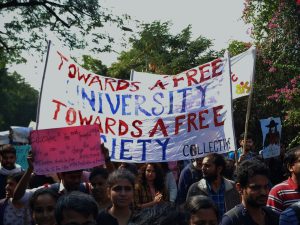
South Asian studies are increasingly affected by attacks on academic freedom.
This is most obvious in countries where authoritarianism is on the rise, as academic freedom is only one of the many liberties which are then suppressed or restricted.
In that case, public universities are primary targets: their budget is cut, their VCs are replaced by fellow travellers or even cadres of the ruling clique, academics are harassed and even arrested under one pretext or the other.
But private universities are not at all in a safer position – in fact they are often experiencing a worse scenario because the owners, most of the time businessmen, depend on the government’s goodwill for many of their projects and, therefore, implement forms of self-censorship and in-house repression even before the state manifests itself.
In both cases, public and private, extremely harsh laws are used against academics, including those passed for fighting against terrorism or sedition. As a result, academics not only lose their jobs, but land in jail too and are not allowed to speak publicly.
To resist these attacks on academic freedom, formal or informal networks have been initiated by faculty members, students etc.
The BASAS South Asian Studies Observatory of Academic Freedom (SASOAF) intends to help them from outside, from UK. The main objective of SASOAF is to document and publicise all kinds of attacks on academic freedom in South Asia: each case needs to be recorded and explained on the basis of all available sources (newspapers articles, personal testimonies, judicial proceedings, interviews of the victims…). This material and a detailed account of the cases will be uploaded on the website of BASAS and disseminated, with a special attention to the media, not only in Britain but worldwide.
Besides South Asia, SASOAF will cover the academic freedom question in UK too. Naturally, the situation is different here. But academics can also be silenced, or intimidated, by groups of the diaspora cultivating an ideological agenda. In this regard, SASOAF may go beyond the collect of data and offer some personal support. Exchange of best practices by colleagues who are experiencing the same type of challenges would then be coordinated by the Observatory.