
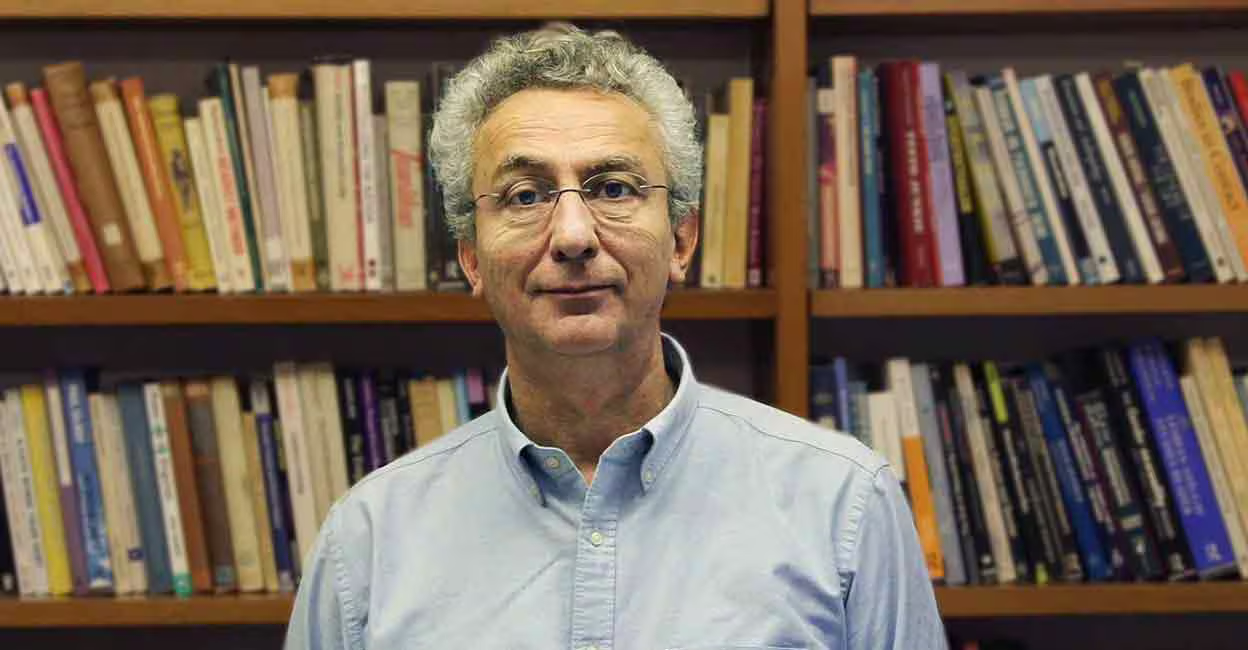
Renowned anthropologist, Prof. Filippo Osella was deported from Thiruvanthapuram international airport just after landing in March 2022. The immigration officials did not give him any particular reason for sending him back. In this detailed interview, he narrates his whole story, how he turned to the UK government and went to court – to no avail. The attitude of his university is not uninteresting either.
***Click here to read the full interview transcript.***
Click here to read Filippo’s statement about his deportation
Click here to read the letter from the Kerala Chief Minister to the Prime Minister of India
Christophe Jaffrelot: Prof. Filippo Osella, you were deported on 24th March 2024 from Trivandrum airport. Could you tell us what happened? And have there been others in your knowledge who have been similarly deported?
Filippo Osella: The number of academics and researchers affected by various bans is much greater than what is known. As you know, people prefer to keep quiet to avoid further troubles and in the hope that bans will be eventually reversed. But it is important to talk openly about these issues and to get institutional and government support. Colleagues from Germany, for instance, have decisive support from their government. I know of two researchers from Germany, one was stopped in the Gulf on his way to India and the other one was deported from India on arrival. The German government intervened immediately, and they were finally allowed to enter India. In my case, I asked both the British High Commission and the Italian Embassy [I am a dual Italian and British citizen] in Delhi to intervene on my behalf, simply to find out the reasons for my deportation and ban. Their input was somewhat insignificant, after an initial online meeting, they didn’t do anything of substance.
And connected to that, of course, is the extent to which both our professional bodies and universities are prepared to intervene on our behalf. In my case, my university refused to contact the Indian High Commission in London to find out the reasons for my deportation. Although I was going to Kerala on an UKRC-funded research grant held at Sussex University, they simply advised me to get in touch with the British High Commission in Delhi. This, I believe, is due to the relationship the university wants to have with the Indian government in order to get students. Similarly, professional bodies like the Association of Social Anthropologists of the UK did not do much. The president was extremely supportive, of course, but basically said “there is nothing I can do, it’s up to you to follow it up”. The British Academy was probably more active, because of a Fellows of the Academy. Unfortunately, there were no tangible results.
I have received hundreds of messages of support, but the vast majority of the people who sent them were clear that it was private support that was given, including by the president of the USA South Asian Studies Association who said, “I know you well and you have all my support. But I cannot intervene on your behalf with the Indian government. I need to preserve access to US academics in India“.
Something else we also need to keep in mind because it is very often at the core of the problems that academics encounter for entering India: the visa regime has changed. Years ago, if you remember, for research visa, after you applied, your visa request went to the High Commission in London, and from there to Delhi, to the Ministry of Human Resources in Development. From there it was sent to the Home Ministry as well as to the States where you wanted to go – and then back. So it took months and months and months. Nowadays you got a research visa within days. And it seems to me that the same level of scrutiny that was taking place before doesn’t take place any more. So effectively, visas are approved by embassies and high commissions rather than going the whole way to Delhi, but there is this some sort of tension, I guess, between what is decided abroad and what is the policy of New Delhi – and this can have consequences when we reach India.
Moreover, the second issue regarding visa is that the rules have changed and it’s practically impossible to find information about new ruegulations. For instance, nowadays if you have a visa that lasts for more than six months, you have to register with the FRO immediately on arrival, even if you stay only three days. If you remember, before you had to register for residence permit only if you stayed for more than six months. Then of course you are asked to produce these documents on exit.
Moreover, for many academics, there is a really fine line between a research visa and a tourist visa. Whenever I did research in India, I always had a research visa. But I also went many times in between on a tourist basis, basically to keep in touch with people I know and friends. And of course, you do not switch your academic mind off: you end up talking about what’s happening. You keep up to date, but on a sort of informal basis. So it’s very difficult to say, “oh, well, I went there and I just went to the beach or visited touristic sites”. This is very difficult to explain to border officials or Indian government agencies. Indeed, many an academic are deported for breaches of visa regulations, accused of “doing research” while on a tourist or business visa.
Two other things which are important to bear in mind. Nowadays, if you do a research that involves talking to government officials, you have to specify on your visa application exactly who you’re going to meet and why. Moreover, you are no longer allowed to stay in other people’s houses during your visits to India. You have always to be staying in a place which can be recorded by the FRO, that is you have to stay in hotels.
CJ: Thank you for contextualising your own case in such a detailed manner. Can you now tell us more about what happened to you?
What happened to me is that I had a three years ESRC-funded research project on the uptake of weather forecasting amongst small scale fishers on the Kerala coast, in collaboration with a Kerala University and the Indian Meteorological Department. These were my research partners. To some extent, it was an unfortunate research from the beginning, because it coincided with the Covid outbreak. So I had to cancel my first research visit because of the covid-related travel ban, and went to Kerala for a month as soon as the travel ban was lifted, and in 2022 I was going back to finish my research, and that’s when I was deported.
I wasn’t stopped neither at Heathrow or in Dubai where they checked the validity of my research visa. They check whether you have a valid visa, and if you don’t have one, they don’t let you board your flight. So neither in London nor in Dubai I was stopped. But as the plane landed in Trivandrum, there was an announcement saying that I had to make myself known to the airport staff who came on the plane. I assumed it was something to do with Covid because in my previous visit, all those who were arriving from UK were taken to a different queue because of Covid regulation. I was told to follow this person and I was taken to the border desk, where I was told that I was not allowed to enter India and I had to board the same plane I arrived with. I asked why, and they said, “we’re not going to tell you anything. We’re not going to talk to you”. I insisted, and they just wouldn’t talk to me. And they threatened, of course, to escort me by force to the plane. At that point I said, okay, I’m going back.
They didn’t give me any reason whatsoever, nor did they give me any information. They didn’t stamp my passport. They didn’t give me any paperwork regarding my deportation. So I had no idea as to why I was told to leave. I was flying with Emirates. Emirates staff was indeed extremely concerned because they said, “you have to go on the plane now to go back”. At the same time, the border officials told me, “if you insist to go through and refuse to leave, you’ll be arrested”. You should know, that it is your right to apply to the High Court for an immediate hearing regarding a deportation if you are on Indian soil, and they wanted to avoid that. They just wanted to get rid of me, I shouldn’t appear anywhere.
Now, it is important to note that border officials were waiting for my arrival. And yet I’ve not been stopped beforehand. I was taken back to Dubai and in Dubai they asked me, “do you know why you’re here, why you’re being deported? Can you show us your deportation order?” I said, “no, I can’t because I’ve not been told”. So there was a back and forth for a while, and eventually I had to pay for my flight back, from Dubai to London.
By the time I arrived in Dubai, there was some kind of panic in Trivandrum. I had organised an end of project conference there with my co-researchers. The conference took place without my presence, but with the extensive presence of CBI [Central Bureau of Investigation] agents who recorded the name of more than two hundred people who were attending the conference.
But when I had been discussing or trying to get information about why I was being deported in Trivandrum airport, someone had recognized me and heard the conversations I was having, and informed the media, including the Malayalam Manorama. So by the time I arrived in Dubai, there were a couple of journalists, one from The Indian Express and one from Manorama, who wrote emails to me asking whether it was true that I was being deported. And I said yes, and that it was indeed true. When I landed then at Heathrow, there was a deluge of emails from journalists asking me why I had been deported and all that.
I had no clue, but I thought it might be because of my trips to Pakistan. In the past these had been an issue. Many a time, the immigration officials asked me, : “You have visas for Pakistan. Why? You’ve been to Pakistan? Why do you have these visas?” And I said, I always responded, I have Pakistan visas because I’ve been to Pakistan on academic-related visits. I’m an academic, I have a regular research visas, and my passport, especially for a research visa, has been seen by the High Commission, so obviously there was no problem. Why is it a problem now?”. So in 2022 I assumed that there was an accusation that, you know, I was working on behalf of Pakistan, that I was a Pakistani spy. On arrival in UK, I thought, I could not let this rumour to go unchallenged. I needed to say my side of the story, and hence I wrote a document and sent it to the newspapers and to whoever asked me [see text of this document after this interview]. But I refused any direct interview.
Soon after, a lawyer from Delhi suggested that I should appeal to the High Court in Delhi, and he offered to represent me pro bono. And so we did. We submitted a plea in which basically we were asking the Government of India to explain the reasons for my deportation and to cancel the deportation order.
So he went in front of the High Court on my behalf. The lawyers from Government of India were there. But they declared that they could not say anything because it was an issue of national security. At that point, the judge, Justice Subramaniam, responded that they had to write a reply to the affidavit that I had submitted. So, in the second sitting, they presented their own version of the events. It had clearly been put together retrospectively. They pointed out three issues. One, of course, referred to past visas; you know, the usual thing. For instance, ”You were in Kerala in June 2012 on a tourist visa, from the first to the fifteenth, and in July 2012 you published an article on Kerala, and it had clearly something to do with the fact that two weeks before you were there and that you did research without any permission – which of course reflects a total ignorance of how academia works, because it takes several months for an article to be published after submission. I also proved that every time I went to India on a tourist visa, I stayed in hotels, in or close to touristic destinations. And I could also prove that when I did research, it was in the framework of a research visa. I wrote to the Indian government lawyers, you just need to read the first footnote on any of my publications that tells you the circumstances of the research, the research grant under which it was conducted, and the dates of fieldwork.
The second issue was transfer of research money. India Government lawyers said, “we looked at your website, and you state that you have a large research grant to do this research with small scale fishers, close to a million pounds. We have no record whatsoever of any transfer of money to research partners in Kerala. I responded that, of course, there was no record because the payments were made by the University of Sussex, not by me. ESRC grants are administered by the university which would not have transferred even a penny if it had not been justified and done in a legal and aboveboard way. So all this didn’t stand up either. And again, I could prove that that were the case.
And the third issue was about my research itself. It was on weather forecasting for small scale fishers, and in one of the coastal villages where we did fieldwork, we installed an automated weather station [AWS] in order to check the accuracy of forecasts broadcasted daily to fishers. Data produced by this AWS were processed and analysed by our research partners, meteorologists at the Cochin University for Science and technology [CUSAT]. . India Government lawyers argued that, “what you did is highly illegal. Coastal areas are border areas, and you didn’t get security clearance and appropriate permission”. They thought that this issue would clinch their argument against me. But the AWS had been installed by the Indian Meteorological Department [IMD], our research partner. The IMD didn’t need any clearance or authorisation because it is an agency of the Government of India. They can set up a weather station wherever and whenever they see it appropriate.
So these were the three issues that, according to the Government of India, justified my deportation, which I could easily refute as unfounded. But they also raised two concerns regarding my visa. The first was that when I arrived in my previous research visit for the research on weather forecasting, I had not reported in person to CUSAT, the university that provided me research affiliation. This was certainly true, due to Covid-related travel restrictions within Kerala. At that time, you couldn’t travel easily and there were concerns about spreading contagion, and so in consultation with CUSAT it was agreed to postpone the formal reporting process. n. The second accusation was that when I arrived for the above research visit, I did not register with the Foreigners Registration Office [FRO]. This is true, because I wasn’t aware that I had to do it, this rule didn’t appear anywhere on India Government visa websites. In the past they stamped on your visa and the visa stated you had to register if you stayed more than six months/180 days. As I was planning to stay just more than one month, I assumed that registration was not necessary. So I didn’t register with the FRO and when I exited India, they didn’t ask me to show and return my FRO registration. So I assumed that everything was fine. I could prove that there was no information regarding changes in visa regulations on the webpages of the Indian High Commission in London. In fact, I could only find information about new registration rules after spending a whole afternoon on an obscure FRO page. When I mentioned that, the CBI officers simply said, “oh, we changed the regulations”.
At that point, the High Court judge was decided that another hearing was needed for the Government of India to respond to my counter-submission in which I had responded to the charges against me. At the next hearing, the India Government lawyers submitted a sealed envelope, saying “here are the real reasons for the deportation. They are reasons of national security, and they can only be seen by the judge”. The judge approached my lawyer and he said, “if I open the envelope, I will have to take a decision and you will not be able to say anything about it, because you will not be able to see the reason for my decision as it’s a matter of national security”. He suggested that we should not pursue further the case but that he will recommend the Government of India to instigate an administrative review of my case within fifteen days. And because it would be an administrative review, the information in this sealed envelope could be revealed to my lawyer. The Government of India, of course, did not even reply.
At that point it came out in all the newspapers that not only I have been deported, but that I was blacklisted for life for very important reasons of national security, which, you know, anyone can read as espionage. Importantly, the evidences presented by Government of India’s lawyers to justify my deportation and ban were collected after my deportation, and thus could not have been taken as the actual reasons for the deportation itself. For instance, the university which provided my visa affiliation and research partner, CUSAT, was approached by FRO officials to provide information only after I submitted the plea to the High Court. Likewise, my university website was consulted for information on my publication and research grants only when the FRO had to provide a report for the High Court.
We returned to the High Court to see the same judge a year later. The judge was rather annoyed with it all, and he asked the Government of India whether they were presenting again the sealed envelope. The Government of India said yes. So the judge opened it and after reading its contents he said, “there is nothing substantial here that adds to the existing accusations, and there are no obvious issue of national security. Plus, you’re not giving a reason for the deportation. You basically reproduce what you said in your counter plea”. At that point, the lawyers of Government of India withdrew the sealed envelope, acknowledging that it was irrelevant. And the only thing that stood was their original response to my plea. Again, the judge issued an order for the Government of India to instigate an administrative review of my case. More than a year has passed since, and nothing happened. It’s a dead issue now, really.
CJ: Thank you Filippo for this very detailed account; that’s very useful for understanding the different players and the procedures.
FO: I forgot to say during the last hearing at the High Court, the judge was extremely annoyed with the Government of India. He issued an order, effectively barring the Government of India to use issues of national security in order to deport foreigners. That was particularly upsetting to the lawyers of the Government of India. They even asked my lawyer to withdraw the case in order to avoid the order from the judge, because it would constitute a legal precedent.
CJ: And did you do it?
FO: No, of course not. I mean, my lawyer was happy to have represented a case which eventually lead to establishing a legal precedent. It happens once or twice in one’s career, he told me.
CJ: So, two additional questions, building on what you’ve just said. If you had to give an explanation, I’m sure you have thought about it again and again, what would be the reason for this deportation, according to you? And secondly, what have you done professionally? I mean, what kind of impact as it had on your career. You had gone to Kerala for? I don’t know, forty years? That was your field…
FO: For the reason/s, I have no idea. I’ve tried to find out informally, through a friend of a friend who is a senior bureaucrat in the Ministry of Foreign Affairs. He found out that my deportation order had been issued by the Prime Minister Office [PMO]. But he explained that my case had emerged in Kerala, instantiated by the FRO in Trivandrum, and then moved up to the PMO. In the past cases like mine would have been dismissed, or you would be fined and banned from entering India for one year or two. That was the usual procedure for trivial cases concerning alleged breaches of visa regulations. But nowadays these cases are taken up by the office of a Prime Minister. Of course, receiving a deportation order issued by the PMO created a huge panic amongst immigration staff at Trivandrum airport. It was apparent that the official who told me that I was barred from entering India to be deported immediately, was utterly terrified of making any mistake.
I tried to explain to myself what the reasons of my deportation and permanent ban from entering India might be. I am sure that it had nothing to do with my ongoing research with small scale fishers who are Catholics and traditionally Congress supporters, hence opposed to the current CPI(M)-led government coalition. The Kerala CPI(M) Chief Minister, Pinarayi Vijayan, wrote on my behalf to Modi supporting me and asking for the cancellation of the ban [see text of letter after this interview]. So it cannot be the CPM. It could be because I wrote stuff on Muslims and reformist Islam, which some non-Salafi organization thought was too sympathetic of Islamism in Kerala. Or it could be visas to Pakistan, but it has never been an issue before. I never wrote anything overtly critical of the political environment in Kerala or India at large, to boot. So I don’t know, it could be anything.
What I know, though, is that the Government of India went as far as to put an international advisory against my name. So now when I cross border, even going to Italy, I spend at least half an hour, three quarters of an hour when my passport is checked and re-checked and all that. I don’t know what the advisories are about but a couple of times I’ve been stopped at the border in Italy for considerable time. When I went to see a friend of a friend who was the Prefetto [Italian state’s representative in a province] in my native town, he told me that delays were caused by a security advisory against my name. What is the advisory about? He wouldn’t tell me. So my deportation and ban from entering India has had these consequences too. Since my deportation I have not tried to go on to the USA or Canada, or to countries where there might be a problem.
Mukulika Bannerjee: Because the Five Eyes intelligence Canada, Australia, UK, New Zealand, US…
But I had two or three questions, Filippo. The specific question first: when your name was called out, were you still on the plane?
FO: Yes.
MB: So even before landing they definitely knew…
FO: No, we had landed. I was called out right after it was announced that we could disembark.
MB: Okay. Because an Emirates didn’t make a fuss about it. Because the airline has to bear the responsibility. And Emirates, the amount of business they do in India, especially with Kerala, and they are big enough airline whether they did anything. That was one question. The second thing was did you ever raise it directly with Shashi Tharoor, given he’s an MP in Thiruvananthapuram? Ah, right. Because I mean, in Francesca’s case, he spoke up immediately and wrote a piece and you know, this is India should have more self-confidence etc. so, you know, we could even retrospectively go back to him and say, okay, this is happening in your backyard when you’re a three time MP from Trivandrum. And the third question was about. What, you know, what you what we think could be the reason. I think reformist Islam, like you say, is one. But do you know what? I obviously have never applied for a research visa because I have an Indian passport. But, I remember from students applying to one that. Is it true that now you can’t you’re told that you can’t study certain things if you want to apply for a visa in India, and is cost one of them? Because this is one of the things I’ve been saying to Christophe that we need to find out this quite you know, we should have the empirical evidence for what you’re allowed to and not allowed to study. And is it your writing about caste that rather than Islam that may have drawn there? I mean, I don’t think any of it is justified. Don’t get me wrong for one second.
FO: No, no.
MB: You should be able to write about anything, frankly, even if it’s incorrect. You know, it’s just bad scholarship if it’s that. But it’s not that in your case. But is it likely to be more along those lines? Because I know caste has come up. Caste and gender Are, topics they don’t want people on research visas to study. Did you come across any of that?
FO: As I said earlier, I believe that emigration officers in Trivandrum acted only once they received a passenger list. Because otherwise they would have stopped me either in London or in Dubai. In fact I remember that in Dubai, after checking my visa on his computer, the Emirates staff said, “oh, research visa, what research you’re doing?”. He was rather jolly and all that.
So, as for Tharoor, he wrote a very sweet email to me saying he was sorry for my predicaments. He would have been the obvious person to get in touch with because I was doing fieldwork in his constituency, coastal areas in Trivandrum district. But Kerala is very fractious, politically wise. Doing or saying anything with a very prominent Congress leader while I the CPM was supporting me would have been unwise. Moreover, I had Keralite co-researchers working with me, so I really didn’t want to make their position more difficult. After my deportation they were all visited and interrogated by CBI about their relation with me and the current research. . So I didn’t want to make things more complicated. Moreover, in Kerala Shashi Tharoor is an ambiguous figure, seen by many in the Congress as a BJP person.
The other question was…
MB: Caste.
FO: Caste, yes. As far as I remember, you never mentioned caste when you submit an application for a research visa. If you’re doing research on caste or gender, you write about Indian culture, Indian traditions and all of that. If you remember, from the early 1970s, well into the 1980s the issue of research visas to social scientists from the USA was severely restricted. North American researchers stood accused of “academic colonialism” and even espionage. So it had become clear by then that certain research topics could be tolerated as long as they were not mentioned explicitly. The difference now is that the university that offers you a research affiliation is held responsible for you and your research. You have to record your arrival, and they have to keep track of what you’re doing, how you’re doing it, how many times you’re visiting, and so on. And they are scrutinised intensively by the central government. The pressure on universities and the controls are under are such that some universities hesitate to offer affiliations. When I was applying for my research visa for the research on small scale fishers, I approached IIT Madras in Chennai, an institution with which I had collaborated many times in the past. But they didn’t give me affiliation because they didn’t want to end up in trouble by hosting a foreign researcher, even though my project was directed to devised better ways to provide small scale fishers with accurate and reliable weather forecasts. As I explained in my plea to the High Court, the research had the objective of making small scale fishing safer, it was about saving lives. We devised and tested a platform to produce localised weather forecasts, which allow fishers to make informed decision on whether to go to sea or stay put during the monsoon season, the most profitable but dangerous fishing season.
Going back to research affiliations, nowadays hosting universities are responsible for you and you’re checked and scrutinized. Universities have also to apply for clearance from the central government when they organise international conferences or workshops. You can apply for a conference e-visa, but only as long as the organisers had been received clearing after giving all the names of participants, their abstracts and so on. So, all international academic events are highly scrutinised. Before the covid emergency, I was invited by Hyderabad University to give a key note speech during an annual event, but they had not sought clearance for my participation. This was mentioned in the counter plea of the Government of India to the High Court I discussed earlier. I explained that I was not aware that permissions were needed as Hyderabad University had not informed of this procedure.
The scrutiny of academic research has intensified, but it has always been there. Kerala, for instance, has always been extremely sensitive about foreign researchers, especially during CPI(M)-led coalition governments. So whenever I did long term research, I was always visited regularly by officers form the State Special Branch [SSB], the intelligence wing of the Kerala police. At times, my neighbours were asked by the SSB to report on what I was doing, who I was meeting and so on. I remember that once, when I was doing research in a village in a paddy growing area, SSB officers came to see me and asked me upfront if I was a Pakistani spy. I replied, “do you think that paddy cultivation in central Kerala is so interesting as to come to the attention of the Pakistani intelligence services? The SSB officers admitted that it would have been highly improbable. In the past, what happened is that perhaps your visa could be refused when you applied, but if you were granted one, there were no further problems.
CJ: And what was not so complicated was to get a university affiliation that you need now. When has the IIT Madras declined to endorse your application for an affiliation, was it?
Filippo: It was when I was applying for the first research visa for the fishers project, in 2019.
CJ: Three years before your deportation.
FO: I had the first visa at the beginning of Covid.
I was going to leave almost on the day that India implemented travel bans. I had a one year research visa and bought my plane ticket, but couldn’t go to Kerala. My visa expired, and I had to apply again 2021. I was issued once more with a multiple entry one year research visa.
CJ: The fact that universities in India are not prepared to endorse the responsibility of affiliating foreign scholars makes collaboration, intellectual cooperation, difficult. But in Europe we are invited by our governments to do more with Indian universities..
FO: This is exactly my argument with my university When I asked for their support after my deportation. I explained that I wasn’t to India out of a personal whim. I was there doing an UKRC-funded research supported, actually encouraged by the university. But they offered me no protection whatsoever. It was absolutely shocking.
CJ: And that was true of the IDS as well as Sussex University?
FO: IDS is an independent organisation. IDS is even more paranoid about losing access to countries like India because they do have contracts with various state governments to assess development projects and all that. They told me that they would have acted behind the scenes to sort out the issues at hand. I totally disagree with that “behind the scene” rhetoric.
I think we have to be totally public about these issues because it’s a about censoring academic research. Moreover, it foregrounds much bigger dangers for our India based colleagues.
As for your previous question, I first went to Kerala, to begin research in 1989. So I have been connected to the state for a long time. Perhaps my permanent ban from India would have been more devastating research-wise for me if I had not been already towards the end of my academic career.
Over the years, I also conducted research elsewhere in South Asia, Pakistan and Sri Lanka in particular, as well as in the Gulf countries of West Asia and China. A couple of years ago, I begun about a research project in Bangladesh where I did a pilot study in Chittagong/Chattogram the working of religious infrastructures. It is a really interesting place. But I was there just before the July 2024 uprising, and many of the people I had been meeting have been incarcerated by the new government. So now I’m a bit stuck on that one as well. Moreover, I only I speak Malayalam [the language spoken in Kerala], I don’t know Hindi, Urdu or Bangla. I am trying to learn Bangla, but I don’t think I will reach the same fluency that I have in Malayalam. Learning Malayalam has been such a long term commitment.
Research in Sri Lanka was easy language-wise because it was focused on Muslims who are Tamil speakers. Malayalam is closely related to Tamil, and so it was relatively easy to communicate. However, it is extremely sad and painful not to be able to visit my very close friends in Kerala.
CJ: And they lose you too. The intellectual exchanges we’ve had for decades with Indian colleagues is badly affected. It’s a lose-lose. Indian institutions will suffer from this loss and suffer already from forms of censorship.
FO: This is one of the points which I raised in my submission to the High Court. I wrote that although I’ve been barred from India for life for reasons of national security, every other month, I’m examining a PhD from students in Indian universities, Indian academics ask me to sponsor their postdocs or support visiting fellowships. I concluded saying that there was an inconsistency between the attempts by Indian Universities to globalize and yet to restrict access to India to foreign academics. I wonder whether colleagues in STEM subjects are having similar problems, or whether this is something to do simply with arts, humanities and social sciences We are targeted as troublemakers.
Text of the statement sent by Filippo Osella to the Indian media after his deportation on 24th March 2022
I am writing this short statement as I finally sit on a bus that is taking me back home from London Heathrow airport to Brighton, after a long 36 hours spent on various planes between UK and Kerala, and back. Today (Thursday 24th March) at 3am I landed at Thiruvananthapuram airport after a rather uneventful Emirates flight from London via Dubai. On arrival, I was taken out of the plane by an immigration official who asked me to follow him to the immigration desk. I thought that this had to do with covid prevention, as it happened when I went to Kerala in September 2021: all passengers whose flight had originated in UK had to follow PCR testing procedures separately from others. So, this time I was taken to the immigration booth, my passport and visa were checked, photo and fingers print taken, all routine immigration stuff. But once these procedures had been completed, with stern words an immigration supervisor informed me that I would not be granted entry, and will be deported back to UK immediately. Indeed, this decision had been taken before my arrival, because an Emirates employee was already present to march me back to the same plane on which I arrived. I was in complete shock because I had a valid research visa issued by the government of India, and once I asked the immigration supervisor and officers as to why I was being deported, I was refused any explanation. In fact the immigration officers refused to talk to me altogether, beyond repeating a couple of time that this was a decision from the Indian government, and they could not discuss it or talk about it. They did not even allow me to get in touch with friends in Kerala or India who could have sought explanations or vouched for my academic status. The immigration officers behaved in a remarkably rude and unprofessional way, even when I tried to explain that I was an academic who had been doing research in India for more than 30 years. In addition, when I asked to be given access to my luggage to retrieve my BP medications before being taken back to the Dubai-bound flight, the reply was that unless I shut up immediately I would be restrained by security. They wanted to get rid of me as quickly and discretely as possible. Without further ado, I was packed on a plane, and sent back home!
I don’t know why I was denied entry and deported, and so I can only speculate on the possible reasons. Clearly, it was not about visa irregularities because there was a one-year multiple entry research visa expiring well after my planned departure from India on 7th April stamped on my passport. For those who are not aware about the procedures, applying for a research visa in India requires submission of substantial documentation, from a full-length project proposal and details about the nature and practical arrangements for the research, to letters of affiliation and support from Indian universities. These documents, along with the applicant’s passport, are sent to the Indian High Commission or Consulate to be thoroughly assessed and vetted by the relevant departments of the Government of India. In other words, research visas are released only when the applicant and the proposed research are deemed to be fully complaint to (with?) the regulations and policies of the Indian Government. To cut it short, the research visa stamped on my passport would have assured any immigration officer that my visit to India was legitimate and approved by the Government of India. What would be the point of approving and issuing research visas, if the latter can be revoked at the drop of a hat, and without explanations?
I am also sure that the decision taken this morning by the Indian immigration authorities is not due to the possible controversial or sensitive nature of the research I am currently undertaking in south Kerala, the reason for my current visit. Not only has this research has been approved by the government of India, but it involves collaborations with (natural and social) scientists from a number of different Indian universities and government agencies. It is a multi-disciplinary research funded by the Economic and Social Research Council (UK) with the objective of finding effective ways to make south Indian small scale artisanal fishers’ livelihoods more secure and sustainable by improving safety at sea. While small-scale/artisanal fishing plays a crucial role in the economy and daily diet of Kerala, fishing is one of the most dangerous occupations in Kerala. Available data based on the calculation of insurance compensations given to fishing families suggest that between 1990 and 2000 one fisher died as the result of an accident at sea every 4 days, while similar data for 2015 to 2021 indicate a slightly lower death rate of one death every six days (needs a clean editing for a lay audience). To increase the safety of artisanal fishers and to make their livelihood more resilient in the face of increasingly hazardous and unpredictable weather resulting to the effects of climate change, over two years we have devised and tested new tools to produce accurate and timely localized coastal weather forecasts. The usefulness and practicality of these communication tools were established through regular discussions with fishers who we trained in the interpretation of weather information and graphics. The preliminary results of the research—co-authored with Indian scientists—have already been published in international journals such as the Journal of the American Meteorological Society, and we are making available all data sets, analyses and outcome to the Government of Kerala, coastal communities and other relevant (governmental and non-governmental) stakeholders. Hardly the stuff of political controversy, then, but solid scientific research directed towards increasing the safety and resilience of Kerala coastal communities. Likewise, I would not even contemplate that my current predicaments might be the outcome of years of research on the social reform movements which have contributed to the development of the Ezhava and Muslim communities in Kerala. My research has also explored other aspects of Kerala life and culture, from gender and masculinity, to Malayali culinary traditions and fashion, and even film stars and their fans clubs (I must confess that I am a great admirer of Mammootty!).
So I guess my deportation might have to do with something else, such as a couple of old Pakistan visas stamped on my passport which are normally treated with some surprise every time I show my passport to immigration officials, but never came in the way of being allowed to cross the Indian border. I am a South Asia specialist—indeed, I am a professor of Anthropology and South Asian Studies at the University for Sussex (UK)—and as well as working on south India, over the years I have also conducted research and attended conferences and workshops in Sri Lanka and Pakistan. My project on Sri Lanka for example, which was funded by the Economic and Research Council focused on ways through which charity might be turned into a means to foster socio-economic development in cities. The latter, supported by the British Council, considered relations between international migration and increased education opportunities in rural Pakistan (I think you should merge the two sentences on Sri Lanka and Pakistan so blur the boundaries, such as my collaborative research projects in charities in urban Sri Lanka and education opportunities in rural Pakistan were funded by the ESRC and the British Council respectively). I have never tried to hide my research trips to Pakistan from the scrutiny of the Indian authorities. I strongly believe in academic integrity and transparency, and so every time I applied for a research visa to India, I declared my visits to Pakistan or elsewhere in South Asia (and I have always been granted appropriate visas for India, regardless of the Pakistan visa stamped on my passport!). And to the questions of immigrations officials about my Pakistan visas, I always responded with the simple truth, “I am an academic and I went to Pakistan for research purposes”. South Asianist scholars are a very expansive and yet tightly knit body of academics. We know each other well, collaborate extensively with each other, we might argue and disagree but deeply respect one another. At the same time, in academic departments the world over, and in any international academic conference, South Asian academics and students work alongside each other, regardless of their nationality. In my academic career as an anthropologist, I have supervised and examined more than 40 doctoral students from all over South Asia, and as well as doing my best to nurture their knowledge and critical skills, I hope to have fostered among them a spirit of academic rigour, mutual understanding and tolerance.
I am utterly shocked and saddened by the deportation order that was served on me today. This is not because it might come in the way of conducting future research in India, but because over the years Kerala has become a second home to me, a place whose culture I love deeply, and where I have countless friends. I have been animated by a passion for understanding the fast-paced transformations of Kerala, one of the most dynamic and culturally rich states in India. And I have always been mindful and respectful of the social complexities of this state, admiring a great deal the efforts of successive governments which, very often against many odds and with limited resources, have greatly improved the lives and aspirations of Malayalis. Indeed, I was relived to be told that my deportation was decreed by an order from the government of India, and not from the government of Kerala. In 30 years of research in the state, I have interacted with and got to know countless politicians, bureaucrats and social activists who always treated me with great respect and generosity, appreciative of my genuine efforts to contribute to the understanding of the (social, economic and cultural) complexities of everyday life in the state. To my surprise, once I landed back in London I turned on my phone to see that I received hundreds of emails and texts from Malayali friends from all other the world, and from Indian and non-Indian colleagues. Make these sentences short and succinct. Their utter disbelief and sadness for my deportation, together with their loving words of support made me choke with tears. I thank them all from the bottom of my heart, and so I also thank all the Indian news media which rushed to report the incident.
I hope this is not my last (attempted) visit to Kerala. I also hope that incidents such as those I experienced today—and which are becoming increasingly common—will not come in the way of collaborations with Indian scientists and universities at a time when the latter are trying tirelessly to internationalise their research endeavours. I’d rather be thinking that I have been the object of plain paranoid bureaucratic foolhardiness which, arrogant and offensive as it might be, should not be allowed to impinge on the pursuit of scientific knowledge. However, my unfortunate experience does not even come close to the predicaments of many Indian colleagues whose freedom of academic expression in recent years has been severely constrained, often making them the object of censorship and disciplinary measures. My thoughts and solidarity goes to them! In the same way, my deportation cannot be compared to the experiences of countless Malayalis who are regularly deported from their country of migration on alleged charges of breaching immigration rules in pursuit of what should be the right to improve one’s life chances. I salute their courage and forbearing!
Filippo Osella – The UK academic who was deported from Kerala
Filippo Osella – ‘I am shocked and saddened, Kerala is my second home’
Who is UK academician Filippo Osella and why has he moved Delhi High Court?